

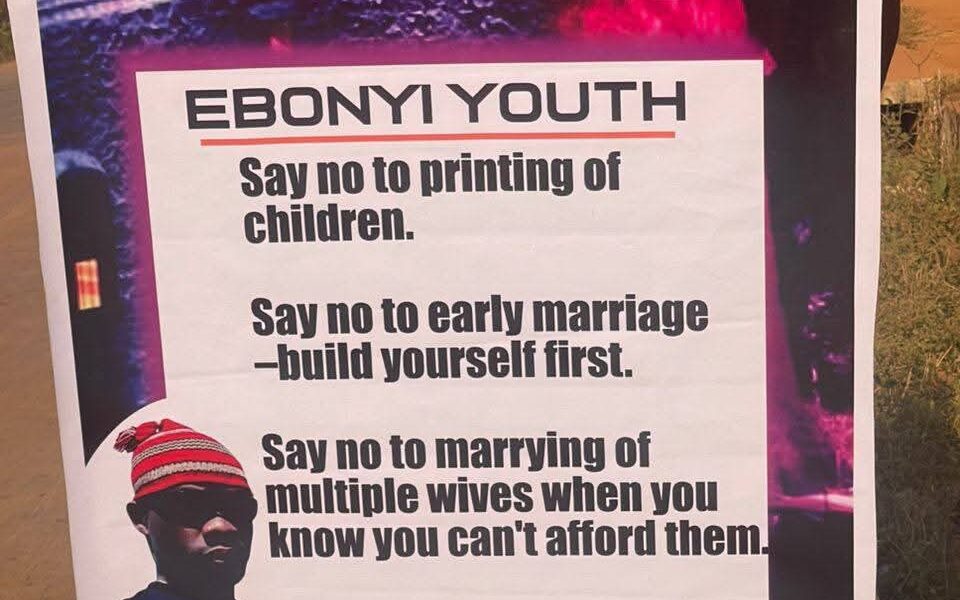
“Stop Printing Children” – Ebonyi Youth Launches Grassroots Campaign to Curtail Early Marriage and Rapid Childbearing

A young man from Ebonyi State who refers to himself on social media as “Nose of the Gods” has stirred public conversation with a grassroots campaign urging young people in the state to rethink early marriage and having many children.
Over the past few weeks, banners created by the activist have been displayed at major junctions in parts of the state, carrying messages that challenge long-held social norms.
In a video shared online alongside the banners, he explained the motivation behind the campaign, saying he wants to help change narratives around why the state continues to lag in development.
He described the campaign as his personal way of supporting Governor Francis Nwifuru’s administration in driving the development of Ebonyi State.
In the video, the campaigner lamented that Ebonyi is often unfairly judged by people from neighbouring states like Anambra because of widespread underdevelopment. He linked this, in part, to a pattern he sees among young people who prioritise marriage and starting families in their early twenties over investing in their personal growth, education, and economic pursuits.
“If you give a 20‑year‑old Ebonyi boy one million naira, he will think first of getting married instead of investing in a business or skill,” he said in the message, stressing that young men and women should think differently if the state is to progress.
Early marriage remains a concern in Ebonyi State, where roughly 13 percent of women aged 20 to 49 were married before the age of 18.
Studies show that early marriage often limits educational attainment and future economic opportunities, perpetuating cycles of poverty and underdevelopment in the region.
He tagged his message/outreach “NO TO EARLY MARRIAGE, NO TO PRINTING OF CHILDREN.”
Supporters have shared and engaged with his posts, while others have expressed discomfort and disagreement with his stance.
The Nose of the Gods campaign, while driven by one individual, taps into larger conversations about youth development, social norms, and economic empowerment, reflecting growing youth-led voices seeking change in southeastern Nigeria.
1 COMMENTS
LEAVE A RESPONSE




Nice movement from him, it should be looked into because is getting too much.