
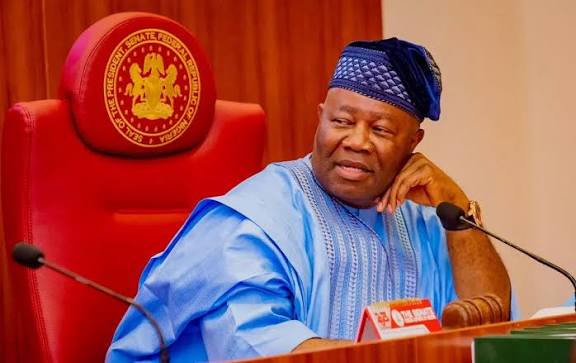
Nigeria’s opposition party, the African Democratic Congress (ADC), has criticised the President of the Senate, Godswill Akpabio, over his comments dismissing concerns about the recently amended Electoral Act.
The criticism followed remarks attributed to Akpabio during a public event in Uyo, Akwa Ibom State, where he reportedly brushed aside complaints from opposition parties about the provisions of the Electoral Act 2026. According to reports, the Senate President insisted that the criticism from opposition groups showed that the National Assembly had made the “right laws.”
Reacting to the statement, the ADC, through its National Publicity Secretary, Bolaji Abdullahi, accused the Senate leadership of promoting legislation that could weaken accountability in Nigeria’s democratic system.
In a statement shared on social media platform X by Abdullahi, the party questioned the justification for a provision in the amended law which, according to the ADC, removes certificate forgery as a ground for challenging election outcomes.
The opposition party argued that such a provision contradicts sections of the Nigerian Constitution that disqualify individuals who submit forged credentials to the Independent National Electoral Commission (INEC) from holding public office.
The ADC further warned that the amendment could create a constitutional conflict and send the wrong signal about ethical standards in public life.
Abdullahi said it was difficult to justify legislation that appears to shield misconduct rather than strengthen democratic accountability, adding that the development could undermine public confidence in Nigeria’s electoral process.
The party also criticised what it described as the dismissive attitude of the Senate President toward opposition concerns, stating that democratic reforms should be designed to improve governance and protect the integrity of elections.
The controversy comes amid wider criticism of aspects of the Electoral Act amendment, which has generated debate among political parties, civil society groups, and legal experts over its potential implications for election petitions and electoral transparency.
While the Senate leadership has defended the amendment as part of ongoing electoral reforms, opposition groups say the provisions risk weakening safeguards meant to ensure credibility in Nigeria’s democratic process.