
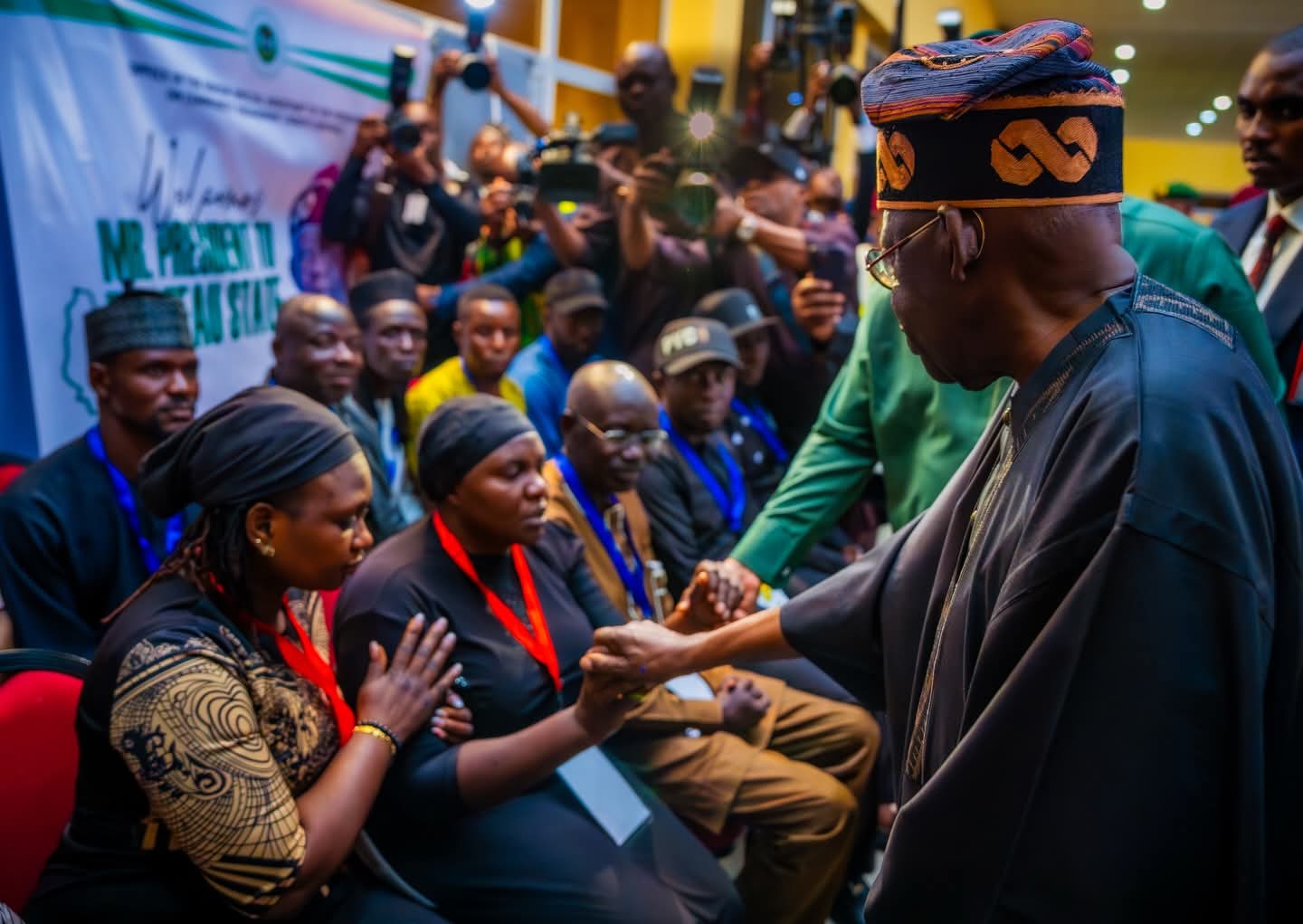
The Presidency has explained the circumstances that led President Bola Ahmed Tinubu to meet victims of the recent Plateau attacks at an airport facility, following criticism from opposition figures and members of the public.
In a State House press release issued on April 3, 2026, Special Adviser to the President on Information and Strategy, Bayo Onanuga, said the President’s movements on the day were shaped by tight scheduling and operational constraints.
According to the statement, Tinubu had two major engagements, including receiving Mahamat Idriss Déby Itno and a planned trip to Ogun State. However, after a security briefing from Plateau State Governor Caleb Mutfwang, the President suspended his Ogun visit to prioritise a trip to Jos.
“After Governor Caleb Mutfwang’s briefing, President Tinubu suspended the trip to Ogun,” the statement said, adding that arrangements were made overnight for the Plateau visit.
The Presidency noted, however, that the bilateral meeting with the Chadian leader “ran longer than expected,” which delayed the President’s departure for Jos.
On arrival in Plateau, further logistical challenges emerged. The statement explained that the airport runway lacked navigational aids required for night operations, making it unsafe to travel into Jos town and return before dusk.
“The constraints made it unfeasible to drive into town, meet victims for on-the-spot assessment and return to the airport before dusk,” Onanuga stated.
As a result, officials arranged for victims and community representatives to be brought to a hall near the airport to enable the President meet them promptly.
The statement added that top security officials, including the Chief of Army Staff and the Inspector General of Police, had earlier visited Rukuba, described as the epicentre of the violence, as part of preliminary engagements ahead of the President’s arrival.
Beyond condolence, the Presidency said Tinubu’s visit was aimed at addressing the root causes of the “recurring, decades-old conflict” in Plateau State.
“He interacted with the victims, consoled them, and listened to them,” the statement said, adding that the President assured residents of justice and decisive action to end the cycle of violence.
Tinubu also promised the deployment of “5,000 AI-enabled cameras” to strengthen surveillance and improve security response in the state, while inviting community leaders to Abuja for further dialogue.
The President’s approach drew criticism from prominent political figures, including Peter Obi and Atiku Abubakar.
Obi criticised the decision to meet victims at the airport, arguing that it fell short of the empathy expected in such circumstances and did not reflect direct engagement with affected communities.
Similarly, Atiku described the visit as inadequate, saying the President’s presence should have extended beyond the airport to the actual communities affected by the violence.
Despite the backlash, the Presidency maintained that the visit achieved its purpose.
“The meeting… was solemn and reassuring, boosting residents’ confidence,” the statement said, insisting that Tinubu’s engagement was “not merely symbolic” but a strategic effort to involve stakeholders in finding lasting peace.
It added that the President’s message was clear: “sustainable peace must be built with the people, not imposed on them.”