
EUGENE, OREGON, USA — June 2026
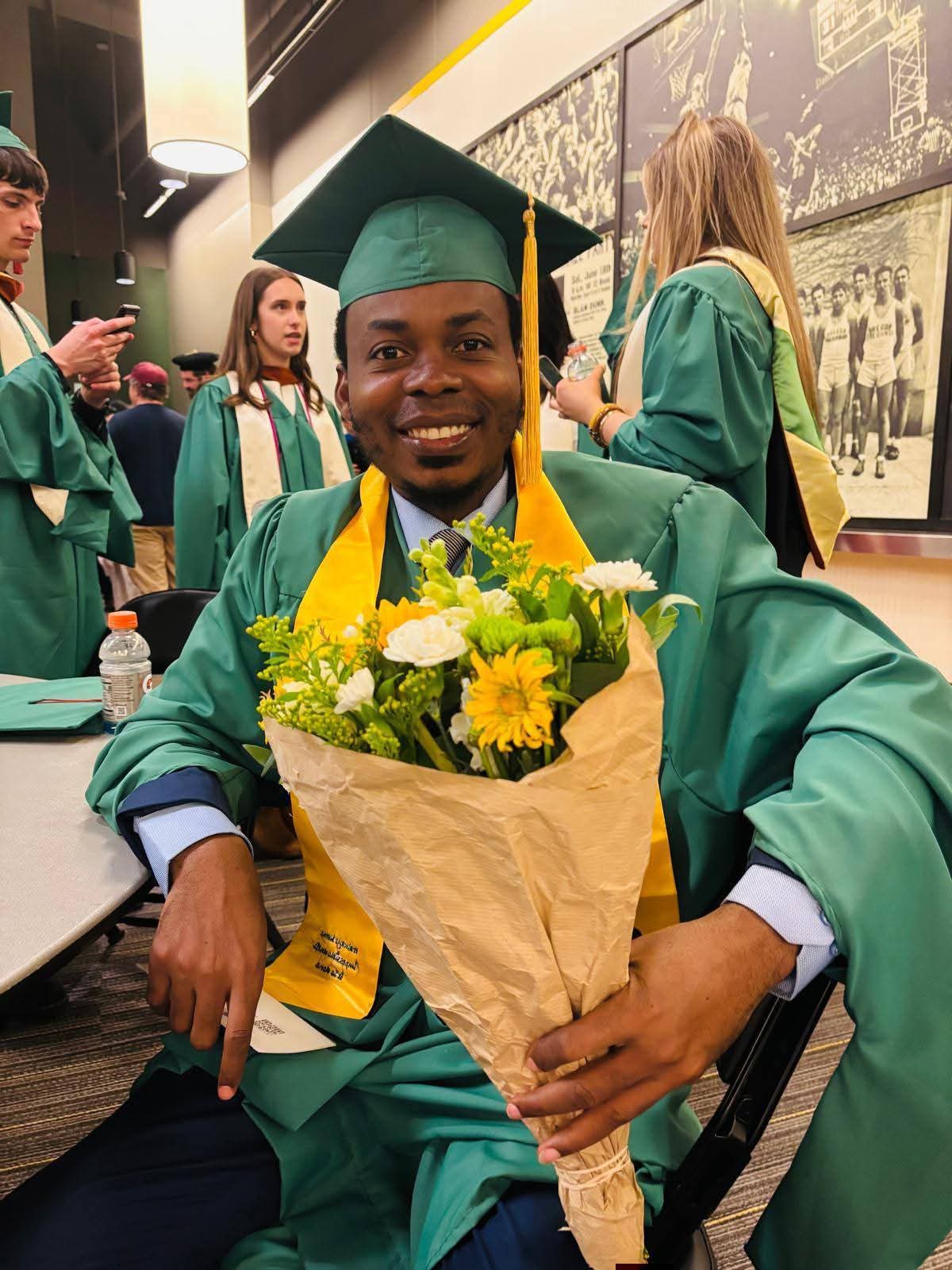
Ebonyi State-born academic and cultural researcher, Maazi Ogbonnaya Okoro, has earned a Master of Arts (Distinction) in Folklore and Public Culture from the University of Oregon, United States, marking a significant milestone in his academic journey and further elevating his profile as one of Nigeria’s emerging global scholars in cultural studies.
Okoro, who hails from Ohaozara Local Government Area of Ebonyi State, Nigeria, publicly announced his graduation alongside a reflection on his academic, teaching, and research accomplishments over the past two years in the United States.
His academic work focused on folklore, indigenous knowledge systems, and cultural identity, with his master’s thesis titled ‘Salt of the Nation: Gender and Power in the Folklore of Salt Production Among the Ọkpọsị-Igbo Women in Southeastern Nigeria.” The research explores gender roles and cultural heritage within Igbo traditional systems.
During his graduate studies, Okoro also served as an instructor and graduate employee at the University of Oregon, where he taught multiple undergraduate courses across departments. His teaching portfolio included:
- FLR 225: Voices of Africa (Department of Folklore and Public Culture)
- FLR 250: Introduction to Folklore
- WR 121z: Writing and Composition (taught across three academic terms)
In total, he taught for five academic terms, handling course design, instruction, and grading responsibilities independently.
Beyond teaching, he worked with the Oregon Folklife Network as a Communication Specialist, gaining experience in public cultural programming and nonprofit communication.
He also received multiple competitive awards and grants, including the John and Joy Haines Endowment Scholarship, the Center for the Study of Women in Society Graduate Research Grant, and the Global Oregon Graduate Research Award.
Okoro’s academic contributions extend beyond the classroom. He has presented papers at international conferences, including the American Folklore Society Annual Meeting in Atlanta (2025) and a joint folklore conference in Oregon (2026).
His research topics range from food culture and identity politics in West Africa to comparative ethnographic studies between Igbo communities and Indigenous groups in the United States.
He is also the author of “Understanding the Igbo Culture of Nigeria” (2025) and a completed monograph titled “Ọmụgwọ: An Ethnographic Study of Pre and Postpartum Rituals in African Folklife.”
Okoro’s work has previously gained recognition within Nigeria. In 2025, he received an “Award of Global Impact in Igbo Studies” from Ebonyi State University, highlighting his contributions to Igbo language preservation and cultural scholarship.
Scholarly and public records also identify him as an Ebonyi-born cultural advocate and Igbo linguist, active in debates on Igbo history, language, and identity in global academic discourse.
Born and raised in Ebonyi State, southeastern Nigeria, an Igbo-speaking region known for its strong cultural heritage and intellectual output, Okoro’s academic trajectory reflects a growing wave of Nigerian scholars contributing to global conversations in humanities and cultural studies.
In his reflection, Okoro described his time at the University of Oregon as transformative, noting that his academic environment exposed him to interdisciplinary mentorship across anthropology, folklore, linguistics, literature, and public policy.
He credited several professors and mentors for shaping his intellectual development and professional outlook.
He concluded his announcement with a personal reflection on his journey from Nigeria to the United States, describing his achievement as the realization of a long-held ambition to teach, research, and contribute meaningfully to cultural scholarship on a global scale.