
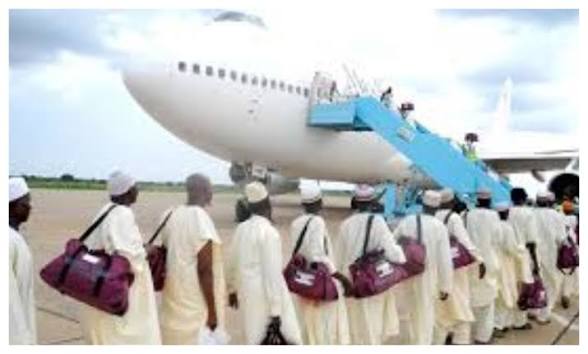
The Jigawa State Executive Council has approved a ₦3.5 billion loan to enable the payment of the 2027 Hajj deposit for intending pilgrims across the state.
The decision was announced on Tuesday by the Commissioner for Information, Youths, Sports and Culture, Sagir Musa, during a briefing with journalists after the Executive Council meeting at the Government House in Dutse.
According to Musa, the approval underscores Governor Umar Namadi’s commitment to supporting the welfare of Jigawa residents.
“In line with His Excellency Umar Namadi’s administration’s proactive commitment to meeting the state government’s obligations, the Council has approved the release of the sum of Three Billion, Five Hundred Million Naira as a loan to the State Pilgrims Welfare Board.”
He explained that the facility would cover the Hajj deposit for 466 intending pilgrims from the state.
“The loan is to facilitate the payment of the 2027 Hajj deposit for 466 intending pilgrims from the state.”
Musa noted that the approval was also necessary to ensure compliance with the requirements set by the National Hajj Commission of Nigeria (NAHCON).
“The Council’s approval is aimed at ensuring the successful participation of its citizens in the 2027 Hajj pilgrimage while complying with the directives of the National Hajj Commission of Nigeria.”
He added that the financial support would allow the State Pilgrims Welfare Board to meet NAHCON’s deadline, which aligns with Saudi Arabia’s requirement for the early completion of contractual arrangements.
“The loan is intended to enable the State Pilgrims Welfare Board to meet the deadline set by the National Hajj Commission as part of its efforts to comply with the Kingdom of Saudi Arabia’s requirement for the early finalisation of contractual agreements.”
According to the commissioner, making the deposit early will help preserve the state’s Hajj allocation while allowing officials to conclude key logistical arrangements in good time.
“The early payment will secure the state’s allocated Hajj slots and facilitate timely arrangements for accommodation, transportation, feeding and other essential services for the intending pilgrims.”
He described the move as a proactive step that would improve coordination and planning ahead of the pilgrimage.
“The Council noted that the early deposit is a strategic measure aimed at ensuring seamless planning and efficient coordination of all activities relating to the 2027 Hajj exercise.”
Musa also called on intending pilgrims to cooperate with the State Pilgrims Welfare Board by completing all registration processes within the stipulated timeframe.
“This is to ensure a smooth and successful 2027 Hajj exercise.”
The Executive Council also approved the award of a contract worth ₦277,214,062.98 for the first phase of renovation work at the Reformatory School in Kafin Hausa.
Announcing the approval, Musa said:
“The Council has approved the award of a contract for the renovation of the first phase of the Reformatory School, Kafin Hausa, at a total cost of Two Hundred and Seventy-Seven Million, Two Hundred and Fourteen Thousand, Sixty-Two Naira, Ninety-Eight Kobo.”
He explained that the project aligns with Governor Namadi’s efforts to strengthen correctional and rehabilitation services in the state through improved infrastructure.
Speaking on the expected impact of the project, the commissioner said:
“The renovation project is expected to upgrade the school’s infrastructure and create a safe, secure and conducive environment for the delivery of rehabilitation services.”
Musa said the upgraded facility would provide juvenile inmates and other residents with opportunities for personal development, preparing them for successful reintegration into society.
“It is aimed at reforming and equipping juvenile inmates and other residents with the skills, discipline and values necessary for their successful reintegration into society as responsible and productive citizens.”
He added that the renovation forms part of the administration’s wider plan to strengthen social welfare institutions and promote restorative justice across the state.
“The Council noted that the project forms part of the government’s broader efforts to improve social welfare institutions and promote restorative justice.”
According to the commissioner, the initiative is designed to address the underlying causes of juvenile crime while expanding opportunities for rehabilitation, personal growth and social inclusion.