
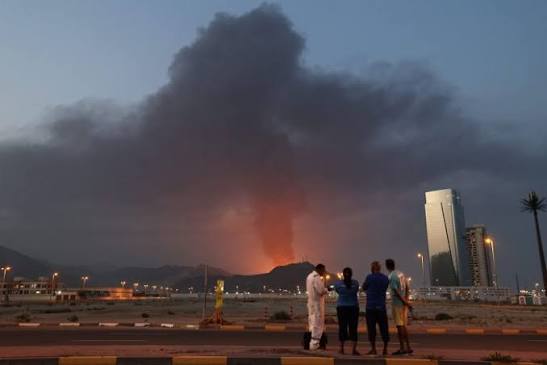
Several Nigerians were among more than 140 residents wounded after Iran launched a wave of ballistic missiles and unmanned aerial vehicles toward the United Arab Emirates, intensifying concerns about the safety of thousands of Nigerian migrants living in the Gulf country.
The UAE Ministry of Defence confirmed on Saturday that its air defence systems intercepted a number of missiles and drones fired from Iran during the latest attack, describing it as a serious escalation in regional tensions.
According to a statement shared on the ministry’s official X account, the defence systems successfully engaged nine ballistic missiles and 33 drones during the assault carried out on March 14.
Authorities said the strikes resulted in six fatalities and left 141 people injured. Among the victims were citizens of the UAE and several foreign nationals.
“The UAE air defence systems on March 14 engaged nine ballistic missiles and 33 UAVs launched from Iran,” the ministry said.
It further revealed that since the beginning of what it described as Iranian aggression, the country’s defence systems have intercepted hundreds of projectiles, including 294 ballistic missiles, 15 cruise missiles and around 1,600 drones.
Officials confirmed that those killed included Emirati citizens as well as foreign residents from Pakistan, Nepal and Bangladesh.
While the exact locations of the casualties were not disclosed, authorities stated that the injured individuals came from multiple countries, including Nigeria.
Other affected nationals were from Egypt, Sudan, Ethiopia, the Philippines, Pakistan, Iran, India, Bangladesh and Sri Lanka.
The list of injured residents also included people from Azerbaijan, Yemen, Uganda, Eritrea, Lebanon, Afghanistan, Bahrain, Comoros, Türkiye, Iraq, Nepal, Oman, Jordan, Palestine, Ghana, Indonesia and Sweden.
The incident has raised fresh fears among Nigerian communities in the UAE, where a large number of citizens are employed in sectors such as construction, hospitality, logistics and small-scale trading.
Figures from Nigeria’s diaspora commission indicate that the UAE remains one of the most popular destinations for Nigerian migrants in the Middle East, particularly in cities such as Dubai, Abu Dhabi and Sharjah.
In recent years, the Nigerian government has repeatedly expressed concern about the welfare and treatment of its citizens in the country, especially amid diplomatic disagreements and visa restrictions affecting Nigerian travellers.
The latest missile strikes have further heightened anxiety among expatriate communities as tensions across the Gulf region continue to rise.
Despite the attacks, the UAE Ministry of Defence maintained that the country’s military remains ready to respond to any security threats.
“The Ministry of Defence remains fully prepared and ready to deal with any threats and will firmly confront any attempts to undermine state security in a manner that ensures the protection of its sovereignty, security and stability, and safeguards its national interests and capabilities,” the ministry stated.
In another update, officials said air defence units were still intercepting incoming missiles and drones.
“UAE air defences are dealing with Iranian ballistic and cruise missiles and drones,” the ministry added.
Reports from regional media suggest that the attacks are part of a broader escalation involving Iran and Western-allied forces in the Middle East.
According to Al Jazeera, Iran has continued missile and drone strikes across parts of the Gulf despite protests from neighbouring countries.
The offensive is believed to be retaliation for military actions carried out by the United States and Israel against Iranian-linked targets in the region.
Late on Friday and into Saturday, Iranian forces reportedly targeted several Gulf states, including Saudi Arabia, Qatar and the UAE.
The strikes also caused damage to infrastructure in parts of the Emirates.
Meanwhile, Iran’s Islamic Revolutionary Guard Corps warned that American interests within the UAE could remain targets.
Iranian state media reported that the group issued the warning after US forces attacked islands said to be under Iranian control.
The IRGC specifically identified ports, docking facilities and military sites linked to the United States as possible targets.
Residents living close to ports and military installations were also advised to move away from such areas to avoid potential civilian casualties.
Security analysts say the exchange of threats and strikes across the Gulf could disrupt economic activities and aviation operations if the conflict intensifies further.
As of the time this report was filed, Nigeria’s Ministry of Foreign Affairs had not released any official statement regarding the development