
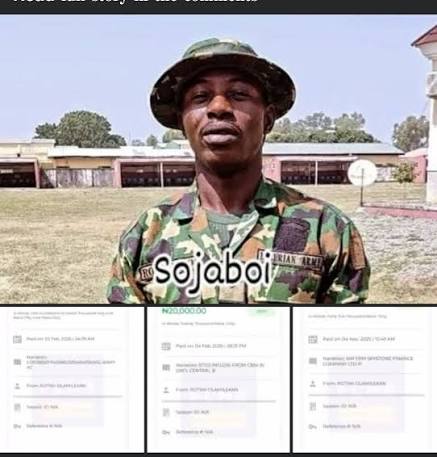
Abuja, Nigeria — Dismissed Nigerian soldier, Rotimi Olamilekan, popularly known as Soja Boi, has stirred fresh controversy over military welfare after presenting bank transaction receipts to support his claims about soldiers’ earnings and working conditions.
The issue first gained attention after Olamilekan appeared in a podcast interview where he criticised conditions in the Nigerian Army, alleging that personnel are poorly paid and often required to purchase their own uniforms and protective gear. His remarks quickly went viral, triggering widespread debate.
In response, the Nigerian Army dismissed his claims as misleading, insisting that soldiers are adequately catered for in terms of salary, kits, and operational needs. The military maintained that standard uniforms and equipment are provided, and any additional purchases by personnel are not compulsory.
Olamilekan was subsequently dismissed from service over what the Army described as acts of indiscipline and violations of its social media policy. Military authorities clarified that his dismissal was tied to breaches of regulations rather than solely his public comments.
Undeterred, the former soldier returned online with what he described as proof of his claims. In a video, he displayed bank alerts showing a monthly salary of about ₦112,000, alongside ₦20,000 labelled as “grumbling allowance” and ₦45,000 as operational allowance, which he said is only received during active deployment.
He further alleged that soldiers often spend personal funds to purchase essential items, including boots, uniforms, helmets, and protective jackets, arguing that these costs place additional financial strain on personnel.
“I am only speaking the truth and showing evidence,” he said, maintaining that his intention was not to discredit the Army but to highlight the realities faced by serving soldiers.
The Army, however, questioned the credibility and context of the receipts, noting that the documents presented were basic bank alerts without official payroll details. It reiterated that soldiers’ earnings are structured under a consolidated system that includes multiple allowances depending on rank and assignment.
The controversy has generated mixed reactions across social media, with some Nigerians backing Olamilekan’s stance as a reflection of reality, while others supported the Army’s position and urged caution in drawing conclusions from unverified claims.
The situation continues to spark conversation around transparency, welfare, and accountability within Nigeria’s military system.