
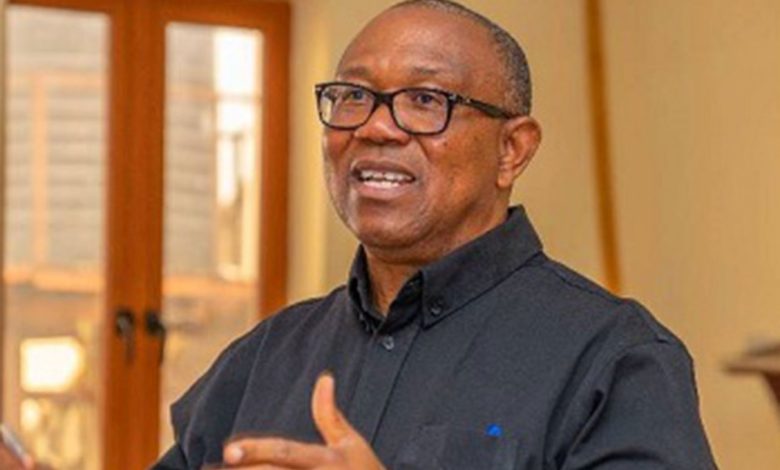
Labour Party’s 2023 presidential candidate, Peter Obi, has unveiled what he described as his vision for a “productive and prosperous Nigeria,” outlining plans centred on education, healthcare, industrialisation and human capital development.
In a statement on Wednesday, Obi said he would, in the coming weeks and months, unveil a comprehensive roadmap aimed at addressing governance failures, improving living standards and repositioning Nigeria for sustainable development.
“Today, being the 1st of July, 2026, I wish to humbly recall that when I decided to contest for the office of President of Nigeria, I pledged to place Nigeria on the path of unity and national transformation,” Obi wrote.
“Now, as the Nigeria Democratic Congress (NDC) candidate, I will, in the coming weeks and months, provide insights into the roadmap that I am confident will help curb abuse in government, halt the decline in the quality of life of Nigerians at all levels, and usher in an era of unity, peace, sustained progress, and prosperity.”
According to Obi, the vision is anchored on “unity, inclusion, social justice, equity, and the freedom of every citizen to pursue lawful dreams,” with education and healthcare forming the cornerstone of his proposed reforms.
He argued that investment in human capital remains essential to Nigeria’s development, saying, “Robust human capital is indispensable infrastructure for national progress. It serves as the fundamental capital upon which daily life, economic expansion, and the delivery of essential public services depend.”
The former Anambra State governor said tackling Nigeria’s out-of-school children crisis would be one of the first priorities of his administration.
“From the outset of my presidency, we will establish a task force dedicated to drastically reducing the menace of out-of-school children,” he said.
Obi also pledged to expand Technical and Vocational Education and Training (TVET), describing it as critical to his industrialisation agenda.
“We will place greater emphasis on Technical and Vocational Education and Training (TVET) to support our drive for massive industrialisation, anchored on our agricultural endowments and value addition across value chains organised around industrial parks,” he stated.
He said TVET institutions would receive improved funding and equipment through partnerships involving government, the private sector and faith-based organisations, with apprenticeship programmes modelled after Germany’s dual education system.
Obi lamented what he described as the contradiction of high unemployment despite Nigerian entrepreneurs moving businesses abroad because of a shortage of skilled workers.
“The situation in which unemployment remains high while Nigerian entrepreneurs establish businesses elsewhere because skilled labour is scarce must be confronted decisively,” he said.
“Doing so is essential for the common good and for facilitating our transition from a consumption-driven economy to a production-driven one.”
He added that character and civic education would also feature prominently in his proposed reforms, saying efforts would be directed at promoting trust, leadership and shared national values as part of his broader governance agenda.