
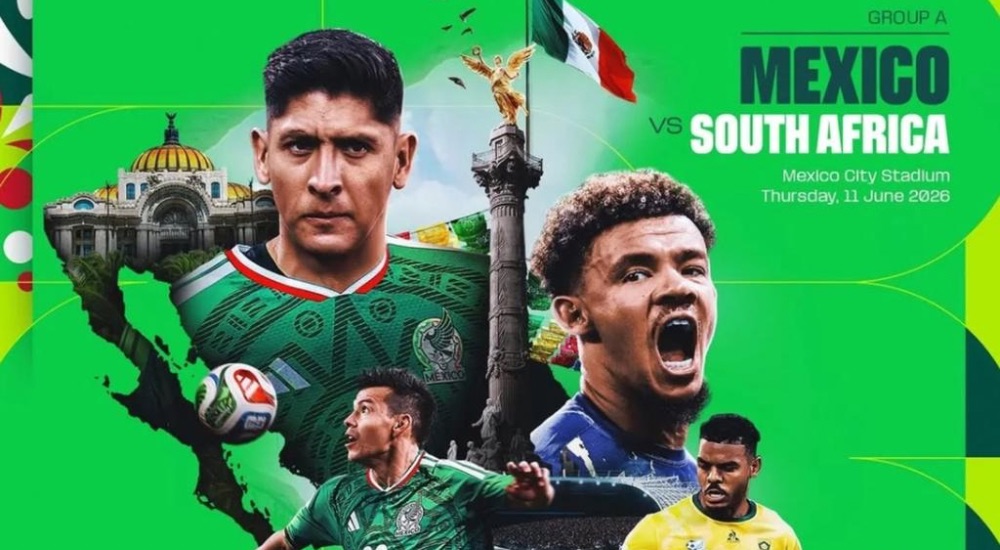
The biggest World Cup in history will unfold across the United States, Canada and Mexico on Thursday.
The Estadio Azteca in Mexico will once again come alive as co-host Mexico meet South Africa in the opening game of the 2026 FIFA World Cup.
Today’s game will be a replay of the 2010 opener in Johannesburg when South Africa hosted the mundial.
The match in 2010 ended 1-1 with Mexico returning in the second half to cancel Bafana Bafana’s fantastic opening goal struck by Siphiwe Shabalala in the first half.
Over 80,000 fans are expected to pack the iconic Estadio Azteca for the high anticipated opener.
Today’s game in Mexico City will mark the start of a 39-day tournament, featuring 104 games – 40 more than we witnessed in the last edition in Qatar 2022.
With an expanded participation pool of 48 teams, the 2026 World Cup is the biggest in the sport’s history, and the first to be held in three countries: the United States, Mexico and Canada.
FIFA had announced that four-time Grammy-winning superstar Shakira, Nigerian Pop Star Burna Boy and other notable artiste including Colombian singer J Balvin and South African singer-songwriter Tyla will lit up the stage before the opening match.
Ahead of this opening cracker, analysts have picked Mexico as clear favourites for the opening day win due to the home advantage and a higher FIFA ranking which is a 15th place as against South Africa’s 60th position. But with more than 80,000 attendees expected, the co-hosts may well find themselves under pressure to deliver the winning start their fans expect.
The El Tri are unbeaten in their last eight matches, equalling the longest unbeaten run they have taken into a World Cup and providing further encouragement for Javier Aguirre’s side before the tournament.
Speaking ahead of the game, South Africa coach Hugo Broos told journalists: “For us, it will be a fantastic experience.
“It is very important that we keep ourselves to the game plan and don’t listen to what is happening in the stands.”
Other opening week fixtures include Canada against Bosnia & Herzegovina, the USA against Paraguay, Brazil vs Morocco, Germany against Curacao and England’s clash with Croatia.
The top two teams from each of the 12 groups – along with the eight best third-placed teams – proceed to the next phase, the round of 32, which has been introduced at the World Cup for the first time.
The 2026 World Cup will be played across 16 stadiums in 16 cities, many of which host matches in the National Football League (NFL), Major League Soccer (MLS), and Liga MX, the top-flight Mexican football league.
Although the World Cup hosting rights are being shared by three countries, the US is hosting 78 games – three times more than Canada (13) and Mexico (13) combined.
The majority of the high-stakes games, including the quarterfinals, semifinals and final, will be played in the US.
The prize money for the 2026 World Cup was confirmed at a FIFA Council meeting in Doha on December 17.
The prize fund for this year’s edition is 50 percent higher than that of the 2022 World Cup in Qatar. Winners this time will pocket $50m (£37.5m), runners-up $33m (£24.8m), third place $29m (£21.8m), fourth place $27m (£20.3m), from 5th-8th place $19m (£14.3m), from 9th-16th place $15m (£11.3m), from 17th-32nd place $11m (£8.3m), from 33rd-48th place $9m (£6.8m).
Each team also receives $1.5m (£1.1m) to cover preparation costs, meaning that every team is guaranteed at least $10.5m (£7.87m).
FIFA’s most recent financial report showed football’s governing body will make $13bn from the four-year cycle culminating in the 2026 World Cup, almost $9bn of which will be in this year.
In comparison, FIFA earned $7.5bn in revenue through four years of commercial deals tied to the 2022 World Cup in Qatar, and $6.4bn for the 2015-2018 cycle leading up to the Russia World Cup.
The Paris 2024 Olympics generated $5.24bn.
The earnings from the 2026 World Cup, spread across North America, will make it the most lucrative sports event to date.